Scientific article · Sources checked October 21, 2026
Copper Peptides and Diabetic Ulcer Recovery: What Wound-Area Measurements Actually Show
A 1994 trial reported better closure of selected plantar ulcers with a topical copper-peptide gel. Understanding the result requires separating wound size, healing speed, infection events, and cosmetic claims.
Editorial source review, with no clinician sign-off or firsthand treatment experience claimed.
A wound that becomes much smaller has improved, but that observation is not identical to a patient having a completely healed wound. This distinction sits at the center of an often-cited copper-peptide study in diabetic ulcers. Its strongest numerical result concerns the median percentage reduction in wound area within one treatment comparison—not the percentage of everyone enrolled who healed. For readers evaluating recovery claims, the denominator and the measurement matter as much as the headline number.
This analysis uses the indexed primary ulcer report and an author-posted full-text transcription, whose original table and figure layout could not be verified. The laser-resurfacing and laboratory comparisons use indexed primary abstracts, not reviewed full protocols or supplements. Together, these records support a focused question: what evidence connects a particular topical preparation to measurable recovery, and where does that connection stop?
In this article
Study facts at a glance
Publication date: The ulcer trial was published in 1994; the later PubMed indexing does not make it a 2006 experiment. Source 1 Source 2
Whole-study population: Enrollment was 181 people with diabetes, averaging 60 years of age—not 181 participants in the headline outcome subgroup. Source 1
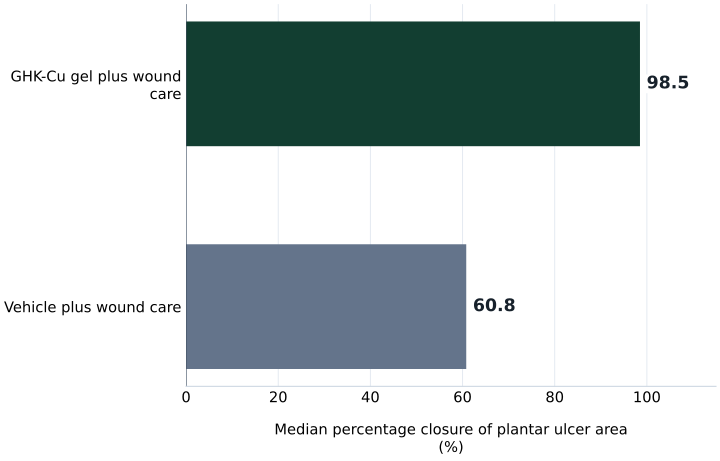
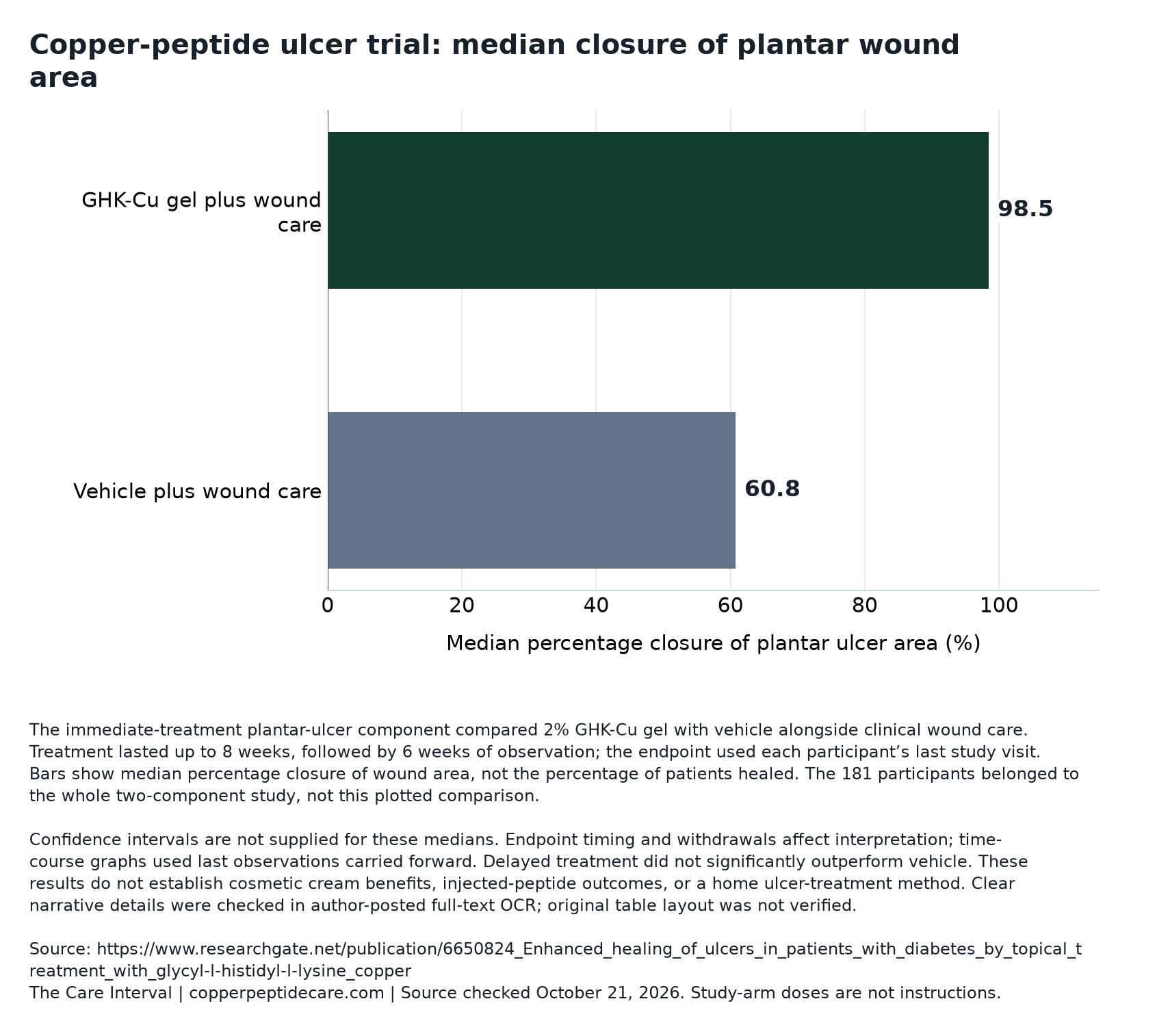
Main numerical finding: The abstract reports median plantar-ulcer area closure of 98.5% with gel versus 60.8% with vehicle. Source 2
Recovery measures differ: Wound-area reduction, linear closure speed, near-complete closure, infection events, and satisfaction answer different questions. Source 1 Source 3
Commercial context: ProCyte supplied the study product; corporate affiliations and an acknowledged development team document commercial involvement, without establishing a specific grant arrangement. Source 1
The comparison was gel added to organized wound care
The multicenter study was randomized, evaluator-blinded, and vehicle-controlled. All groups received standardized debridement, pressure-relieving footwear, and education. The topical study arms used 2% or 4% GHK-Cu in an HPMC gel vehicle. These historical exposures identify experimental preparations, not instructions for treating a wound.
The methodological question is therefore incremental: does adding the tested ingredient improve results beyond the shared care program and gel base? A vehicle is the preparation without the active ingredient. It helps separate an ingredient-specific effect from effects associated with the surrounding treatment. Evaluator blinding reduces the opportunity for knowledge of treatment assignment to influence measurement, but does not itself establish that participants were blinded or that every possible bias was controlled.
Interpretation: the supportive-care background is part of the result, not background noise to subtract from the story. An ingredient studied alongside organized clinical care has not thereby been tested as a replacement for that care. Nor does randomization make every later subgroup estimate equally precise; dividing an enrolled population creates smaller comparisons.
Read the underlying chart data: download CSV or download the source-labeled chart.
Treatment timing created separate scientific questions
The immediate component allowed eight weeks of treatment followed by six weeks of observation. The delayed component used a four-week vehicle lead-in before eight additional weeks of assigned treatment. The headline medians belong to immediate-treatment plantar ulcers. Delayed active treatment did not significantly outperform vehicle.
These schedules should not be collapsed into a single claim about everyone exposed to copper peptides. Beginning an intervention at different stages of recovery changes what is being tested. An early response can also make a later before-and-after comparison misleading: a slower second period need not mean the later intervention caused slowing, because the underlying recovery trajectory may already be changing.
Interpretation: timing-dependent results generate hypotheses about the wound environment, but do not establish why an effect differs. A useful follow-up study would distinguish a biological timing interaction from differences in the wounds still open when delayed treatment begins. The observed comparison does not justify telling readers when to apply a retail product.
A percentage of area is not a percentage of patients
Area closure expresses change relative to each wound’s starting area: starting area minus remaining area, divided by starting area, multiplied by 100. It is a continuous measurement, meaning that many intermediate values are possible. A patient-level healing proportion is different: each person either meets a specified healing definition or does not, and the proportion depends on a patient denominator.
Illustrative reasoning: suppose a hypothetical wound begins at 200 square millimeters and ends at 20. Its area closure is 90%, but an open area remains. Another wound might reach the same percentage from a very different starting size. Neither observation alone establishes wound depth, durability of closure, comfort, or return to normal activity.
The table separates three readings that are easy to confuse. The distinction also matters when comparing appearance claims in the copper-peptide routine guide: a numerical endpoint should retain its original unit rather than become a broader promise.
How to read a wound-recovery number without changing its meaning
| Measurement | Question it answers | What it does not establish |
|---|---|---|
| Percentage area closure | How much smaller is a wound relative to its baseline? | The percentage of participants completely healed |
| Proportion meeting a closure threshold | How many participants meet a defined criterion? | That all remaining wounds improved equally |
| Normalized linear closure rate | How quickly does the wound edge advance after accounting for geometry? | A matching multiplication in the number of healed patients |
Why medians and negative closure values need context
The abstract reports 89.2% versus −10.3% median closure in larger plantar ulcers, using a threshold above 100 square millimeters. The full-text transcription differs slightly in its boundary wording and implies 10.4% enlargement. Those small inconsistencies remain unresolved; neither should be silently corrected into a verified figure.
The negative sign has a straightforward interpretation: remaining area exceeded starting area. Illustratively, a wound growing from 100 to 110 square millimeters has −10% closure. There is no such thing as a negative percentage of patients healing. Meanwhile, an enlarging wound can become much larger than baseline, whereas improvement stops at complete area closure. That asymmetry can pull an arithmetic mean downward.
A median identifies the middle of an ordered distribution and is less sensitive to extreme enlargement. But it does not describe the whole distribution. Subtracting two medians gives a difference between group summaries, not the typical individual treatment benefit. Larger-ulcer findings are therefore informative without establishing that every larger wound responded or that initial size alone predicts benefit.
The final measurement was not a common fourteen-week visit
Weekly wound tracings supplied planimetric area measurements. The endpoint used each participant’s last visit, whether departure followed closure, an adverse event, or another reason. Longitudinal graphs carried the last measurement forward; four participants had only a prestudy evaluation. Thus, inclusion in analysis did not mean equal observed follow-up.
This matters because an endpoint can combine outcomes measured after different amounts of time. Illustratively, a wound measured when someone leaves early is not necessarily comparable to one observed through the full planned period. Carrying a value forward keeps that participant represented numerically, but assumes the recorded status can stand in for later unobserved status. It neither documents continued improvement nor proves deterioration stopped.
A stronger recovery account would distinguish scheduled follow-up, actual observation, and assumptions used after observation ends. Sensitivity analyses could ask whether plausible alternative outcomes for missing visits materially change the comparison. Without those checks, a clear-looking trajectory may be more certain visually than the underlying observations warrant. Calling the endpoint a universal fourteen-week result would obscure this issue.
Faster closure is not the same as more people healed
The abstract describes a threefold closure-rate advantage. The full report identifies the measure as normalized linear wound-edge advance, in millimeters per day, in the immediate plantar comparison. Confidence intervals are not supplied in the accessible text.
A geometric rate and a healing probability cannot be exchanged. Illustratively, moving an edge inward more quickly may reduce open area, but the relationship depends on wound shape, starting dimensions, interruptions, and the observation period. A rate ratio therefore cannot be read as three times as many people healing, nor as a guaranteed shortening of recovery to one-third its previous duration.
Confidence intervals would help show the range of effect sizes compatible with sampling uncertainty. A statistically significant result alone does not distinguish a narrowly estimated effect from a much less precise one. For future trials, pairing an area measure with time to confirmed closure and clearly reported uncertainty would make the practical recovery meaning easier to judge.
Infection findings deserve a narrower reading than general safety
The abstract reports ulcer infections in 7% versus 34% of the immediately treated plantar subgroup. Overall adverse-event rates did not differ significantly across gel and vehicle groups. The protocol withdrew participants whose infections failed to respond after a week of treatment.
The infection percentages describe a specific comparison, not infection prevention in all participants or all settings. Their arithmetic difference is 27 percentage points; it is not a 27% relative reduction. Without a verified subgroup denominator and confidence interval, converting that contrast into a number needed to treat would introduce unsupported precision.
An overall nonsignificant adverse-event comparison also does not prove equal safety. Different types of events can move in different directions, and limited observation can miss uncommon harms. Withdrawal after an unresolved infection makes subsequent outcomes particularly relevant to interpretation. As the irritation and expectations guide emphasizes for a different setting, an unwanted reaction is an outcome to document, not evidence that a product is working.
Laser recovery separates satisfaction from measured improvement
A separate randomized post-CO2 circumoral resurfacing study had 13 completers. Its abstract found no significant between-group advantage for redness resolution or twelve-week objective wrinkle and skin-quality assessments. A patient questionnaire favored GHK-Cu for perceived skin quality or satisfaction, with P = .04; effect sizes, confidence intervals, and adverse-event counts were not reported.
Patient experience is meaningful, but it answers a different question from a blinded image assessment. A person can value a regimen without an instrument detecting faster recovery. Conversely, a small nonsignificant comparison cannot establish equivalence. The two findings should remain side by side rather than being forced into a single verdict. The laser-resurfacing analysis examines that distinction in its procedure-specific setting.
The studies below occupy different evidentiary levels. None becomes a substitute for another merely because the ingredient name overlaps.
Different experiments answer different recovery questions
| Evidence setting | Relevant observation | Boundary of inference |
|---|---|---|
| Diabetic-ulcer clinical trial | Wound-area and closure-rate comparisons | Not a trial of facial appearance |
| Post-laser clinical trial | Objective recovery assessments and patient questionnaires | Not routine use on intact skin |
| Fibroblast cultures | Collagen synthesis and matrix-remodeling signals | Not patient healing, satisfaction, or product safety |
Cell experiments suggest remodeling, not a cosmetic guarantee
One fibroblast experiment found increased collagen synthesis without increased cell number. Another found increased MMP-2 and its messenger RNA, alongside increased secretion of TIMP-1 and TIMP-2. Copper ions reproduced the MMP-2 response; GHK alone did not. These are laboratory observations, not clinical outcomes.
Fibroblasts are connective-tissue cells. Matrix metalloproteinases help break down extracellular material, while tissue inhibitors of metalloproteinases regulate those enzymes. Seeing signals on both sides of that system suggests remodeling is more complicated than simply accumulating collagen. A molecular change can be biologically interesting without establishing whether tissue ultimately becomes more functional, more comfortable, or visibly different.
The translational gap includes formulation, tissue access, exposure duration, and the condition being treated. An ingredient contacting cultured cells does not demonstrate that a finished serum reaches the same cells at a comparable exposure. The face, neck, and body evidence guide addresses a related problem: even anatomical extrapolation requires support. Laboratory concentrations should not become consumer application targets.
A product or care contract needs its own documentary evidence
Interpretation: evidence should follow the tested preparation, route, population, and endpoint—not simply the shared phrase copper peptide. A wound gel result does not validate a facial cream, compounded preparation, oral product, or systemic injection. An appealing mechanism cannot fill those missing comparisons.
For someone assessing a service, the documentary question is separate from biological plausibility: what exact item is described, which claims have supporting records, and what obligations appear in the written terms? The AgelessRx review and Defy Medical review can be used to check those documentary questions. These links do not establish access to the trial preparation, diabetic-ulcer care, or comparable outcomes.
A useful evidence record preserves the product identity and intended setting before comparing claims. The consultation product-list guide offers an organizational framework, not an efficacy test. Neither a provider’s involvement nor a detailed product description supplies the missing clinical bridge. The appropriate conclusion remains specific to the experiment rather than expanding to a category-wide recovery promise.
Questions about the evidence
Did almost everyone receiving copper peptides heal?
The headline area statistic cannot answer that question. A median summarizes ordered wound measurements, whereas a healing proportion requires a verified count meeting a defined criterion and an appropriate denominator. The report also considered near-complete closure separately. Its categorical table is not reproduced here because the transcription’s layout is insufficiently reliable.
Why not use all enrolled participants as the denominator for every result?
Enrollment describes the entire study, but a subgroup result concerns only the people in that comparison. Substituting the larger enrollment denominator would make precision appear greater and could misstate event counts. The population, treatment timing, and ulcer location must stay attached to each estimate.
Does a nonsignificant comparison mean nothing changed?
No. A between-group test asks whether the evidence distinguishes groups, not whether either group changed over time. Both groups can improve while their difference remains uncertain. Equally, an underpowered comparison may fail to distinguish clinically meaningful effects. Nonsignificance is not proof of identical outcomes.
What would make a modern replication more informative?
Useful features would include a prespecified primary endpoint, verified arm sizes, transparent withdrawals, confidence intervals, and analyses testing missing-data assumptions. Confirmed durable closure and patient-reported recovery could complement area measurements. Those additions would clarify whether a numerical wound change translates into a recovery benefit people experience.
Does the ulcer result support putting cosmetic copper serum on a diabetic wound?
No. The preparation and clinical context are integral to the evidence. A cosmetic serum is not established as equivalent to the trial gel, and this study does not provide a home-treatment pathway. Diabetic wounds require clinical assessment; ingredient overlap is not evidence of interchangeability.
What this evidence supports
The ulcer study provides a clinically interesting, preparation-specific signal in an immediate-treatment plantar comparison. Its strongest lesson for recovery claims is methodological: preserve the endpoint, denominator, timing, and comparator. The accessible evidence supports neither a universal healing percentage nor a cosmetic benefit inferred from wound closure. Satisfaction after a procedure and laboratory remodeling signals add different kinds of information, not independent confirmation of the same outcome. A convincing broader claim would require direct testing of the actual preparation in the intended setting, with transparent follow-up and estimates precise enough to judge practical benefit.
Research access and limitations
The ulcer analysis uses an author-posted primary full-text OCR and indexed abstract. Original table and figure layout was not verified, so ambiguous arm counts and categorical rates are excluded. Minor abstract–transcription discrepancies remain identified rather than resolved speculatively. Laser and cell-study evidence is abstract-only. Trial reports are not current prescribing information.
Sources behind this reading
- Mulder et al., 1994: GHK-Cu in diabetic neuropathic ulcers (author-posted full text) ↗Author-posted primary full-text OCR; original table and figure layout not verified · Checked October 21, 2026
- Enhanced healing of ulcers in patients with diabetes by topical treatment with glycyl-l-histidyl-l-lysine copper. ↗Indexed primary study abstract · Checked October 21, 2026
- 2006 CO2 Laser Copper-Tripeptide Study: Accessible Abstract ↗Primary study abstract only · Checked October 21, 2026
- Stimulation of collagen synthesis in fibroblast cultures by the tripeptide-copper complex glycyl-L-histidyl-L-lysine-Cu2+. ↗Indexed primary laboratory-study abstract · Checked October 21, 2026
- The tripeptide-copper complex glycyl-L-histidyl-L-lysine-Cu2+ stimulates matrix metalloproteinase-2 expression by fibroblast cultures. ↗Indexed primary laboratory-study abstract · Checked October 21, 2026