Scientific article · Sources checked October 21, 2026
Copper Peptides After CO2 Laser: Separating Satisfaction From Measured Recovery
A small randomized study found a patient-reported benefit without a detectable advantage in redness or blinded appearance ratings. Understanding that split is more useful than treating it as either proof or failure.
Editorial source review, with no clinician sign-off or firsthand treatment experience claimed.
After a resurfacing procedure, recovery has several meanings. Skin may look less red, an evaluator may judge its texture differently, and the person recovering may feel more satisfied with its appearance. These outcomes overlap, but they are not interchangeable. For copper peptides, the important scientific question is not simply whether an ingredient “works.” It is which part of recovery was measured, against what comparison, and with enough precision to support which conclusion.
The relevant evidence includes a small post-laser clinical experiment, a separate diabetic-ulcer trial, and laboratory studies of connective-tissue cells. This analysis uses the indexed primary report abstracts for the laser and cell experiments, together with an author-posted full-text optical character recognition transcript of the ulcer report. That access supports a careful comparison of study questions, but not a claim that every protocol, supplement, or original table layout has been examined.
In this article
Study facts at a glance
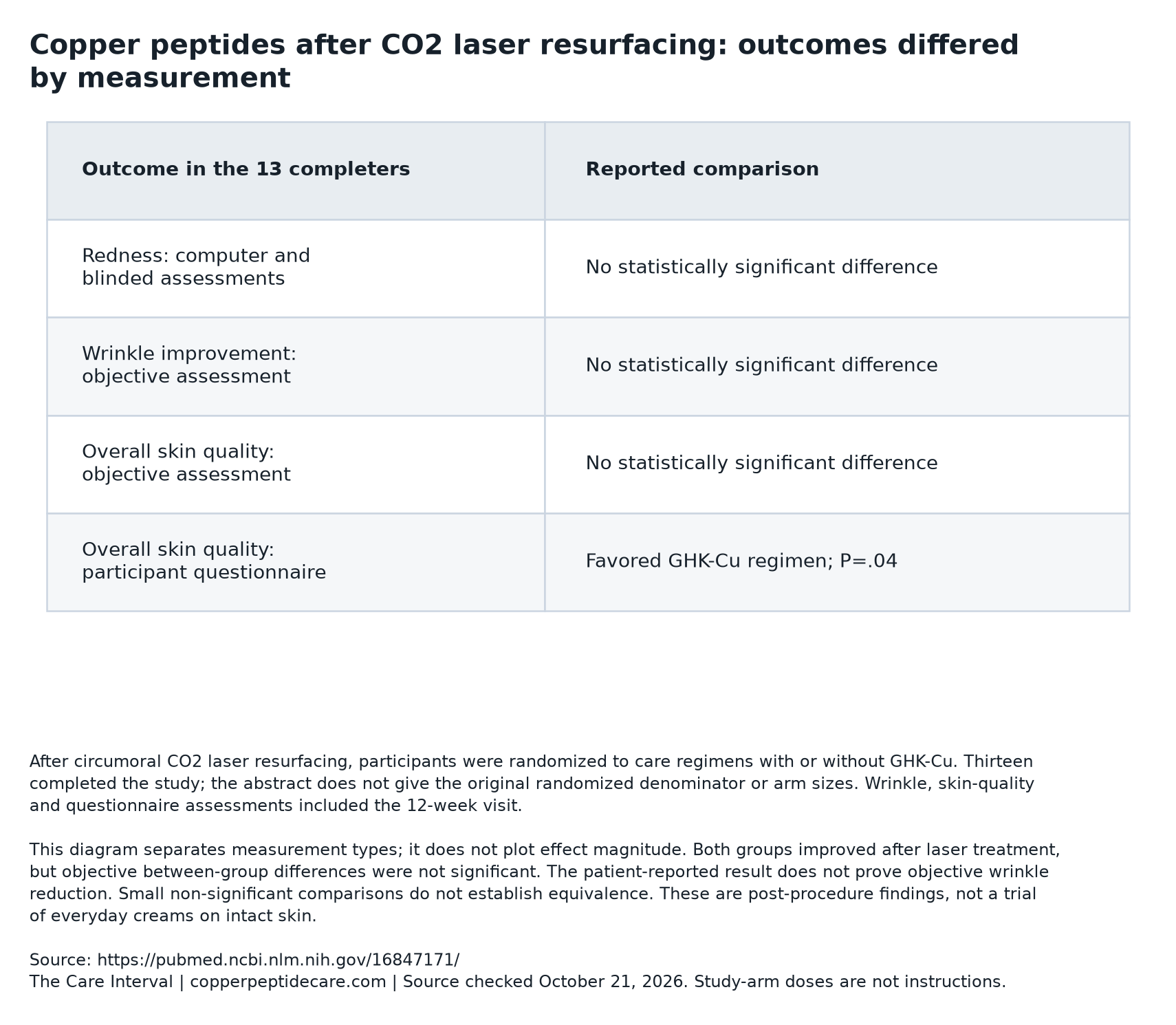
Laser-study population: Thirteen patients completed the study; the abstract does not report the number initially randomized or the number in each arm. Source 1
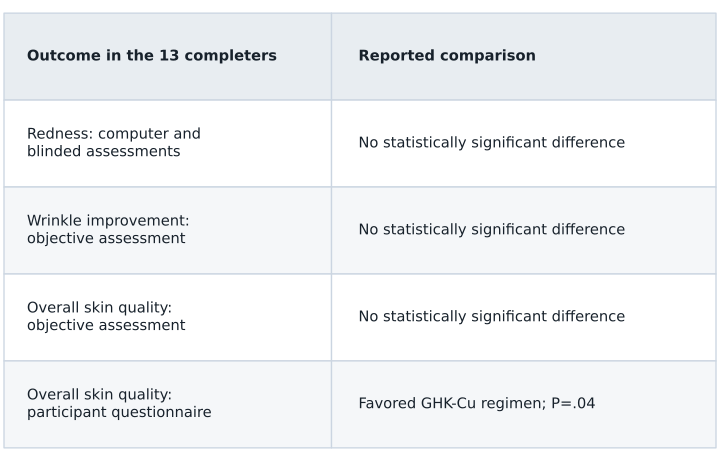
Objective laser outcomes: No statistically significant between-group advantage was reported for redness resolution, wrinkles, or overall skin appearance. Source 1
Patient-reported outcome: A questionnaire favored the GHK-Cu regimen for perceived overall skin quality or satisfaction, with P = .04. Source 1
Separate wound evidence: The ulcer trial enrolled 181 people overall; its immediate-treatment plantar-ulcer findings do not describe that entire population. Source 2
Mechanism versus recovery: Fibroblast experiments address biological responses in culture, not demonstrated delivery or clinical benefit from a facial formulation. Source 4 Source 5
The comparison was an addition to post-procedure care
The 2006 trial randomized patients after CO2 laser resurfacing around the mouth to topical care regimens with or without GHK-Cu, a copper-bound tripeptide. Computer analysis and blinded evaluators assessed erythema, meaning redness; appearance assessments and a validated patient questionnaire included a 12-week evaluation.
The design asks an incremental question: what does adding the copper-containing regimen contribute beyond the procedure and comparison care? It does not compare copper peptides with doing nothing, and it does not isolate the effect of laser treatment itself. Those distinctions determine the claim the experiment could establish even if its results were unequivocal.
A recovery intervention also needs an outcome that matches its proposed purpose. Earlier redness resolution, better final appearance, and a more favorable recovery experience would require different evidence. A general product description that bundles them together makes the comparison less clear. The product-list consultation guide offers a way to keep the identity and intended role of each preparation explicit.
Read the underlying chart data: download CSV or download the source-labeled chart.
Improvement after laser is not an added-product effect
The report describes improvement after treatment in both groups, without an objective between-group wrinkle or skin-quality advantage. This separates two different calculations: change within each group and the difference between those changes. Only the latter addresses whether the added regimen outperformed its comparator.
Illustrative reasoning: suppose two hypothetical groups improve by eight and seven points on the same scale. Both have improved substantially from baseline, but the estimated incremental difference is one point, not eight. Whether that one-point contrast is credible or meaningful depends on measurement variability, sample size, and what the scale represents. These invented numbers explain the comparison; they are not trial results.
The same logic prevents the opposite mistake. A nonsignificant comparison does not mean that skin remained unchanged over time. It means the analysis did not establish a difference between regimens. When discussing a procedure followed by several products, crediting all visible improvement to one ingredient bypasses the very comparison the trial was designed to make.
A satisfaction signal deserves its own interpretation
Patient reports are not automatically inferior to instrument readings. Satisfaction can be an important outcome when the intervention concerns appearance and recovery. But satisfaction answers a different question from whether redness disappeared sooner or whether blinded raters detected a larger cosmetic change.
The reported P value does not tell readers how much better participants felt. A P value describes how compatible the data are with a specified statistical model under a null hypothesis; it is not the probability that the treatment works. Without a difference expressed on the questionnaire scale and an uncertainty interval, statistical significance cannot be converted into a practical magnitude.
Several explanations could fit a subjective–objective split: the measures may capture different experiences, one may detect smaller changes, or sampling variation may matter. The accessible evidence does not select among those possibilities. It therefore supports preserving the patient-reported finding as a distinct signal, rather than using it to overwrite objective results or dismissing it because other measures differed.
Different recovery measures answer different questions
| Measure | Question it addresses | Inference it does not establish |
|---|---|---|
| Redness assessment | Does the measured recovery sign differ between regimens? | Whether participants prefer the regimen |
| Blinded appearance assessment | Is a visible appearance difference detectable under the evaluation method? | How much the individual values the result |
| Patient questionnaire | Does the person report a better experience or perceived result? | Faster biological healing or an objective wrinkle advantage |
Thirteen completers leave the size of the effect unresolved
The laser abstract supplies no arm counts, initial enrollment, attrition explanation, concentration, effect-size confidence intervals, funding disclosure, or adverse-event counts. It also does not establish a primary-endpoint hierarchy. These omissions matter because they limit reconstruction of the comparison, not because they prove anything unfavorable happened.
An equivalence conclusion requires more than a nonsignificant test. Investigators ordinarily need a prespecified range of differences considered acceptably small and sufficiently precise estimates to rule out differences outside that range. A small study that fails to separate two groups may still be compatible with benefit, little effect, or disadvantage.
A confidence interval would help distinguish those possibilities by displaying the uncertainty around an estimate. Without it, readers cannot tell how tightly the experiment constrained the added effect. Nor can they assess how the number of outcomes tested affected interpretation of the isolated positive finding. That makes this a reason to seek replication with clearer reporting, not a basis for declaring either equivalence or definitive efficacy.
A resurfaced mouth area is not an intact-face serum trial
The tissue setting is part of an intervention, not incidental background. To transport a result to another setting, researchers need reasons to expect comparable exposure and a comparable biological response. Sharing an ingredient name alone does not establish either condition.
There are several separate bridges: from treated tissue to intact skin, from a study regimen to another formula, from a localized procedure to broader application, and from a measured endpoint to a marketing promise. Each bridge can fail independently. Even strong evidence at one end would not eliminate the need to test the other end.
This is why a routine discussion should remain separate from a post-procedure claim. The guide to copper peptides alongside existing actives addresses the former context, while the face, neck, and body evidence guide examines another transport question. Neither type of routine framework turns a localized laser experiment into evidence for retail creams, compounded preparations, oral products, or systemic injections.
The ulcer experiment tested a different recovery problem
The 1994 multicenter randomized, evaluator-blinded trial compared topical gel with vehicle alongside standardized wound care, including debridement and pressure relief. Immediate treatment used 2% gel for up to eight weeks, followed by six weeks of observation. A delayed component used four weeks of vehicle before eight weeks of vehicle, 2%, or 4% gel.
These are historical study arms, not application instructions. The comparator was vehicle—the formulation base without the active complex—not absence of wound care. Consequently, any added effect belongs to a combined care setting. It cannot reasonably be interpreted as evidence that an ingredient substitutes for the supporting clinical program.
The separate analysis of the diabetic-ulcer study develops that clinical question in more detail. For interpreting laser recovery, its main value is methodological: an intervention's performance may depend on tissue condition, accompanying care, and timing. A positive result in one wound setting neither resolves a different cosmetic comparison nor makes those two experiments contradictory.
Area closure, healing frequency, and recovery speed are different quantities
In the immediate-treatment plantar component, median area closure was 98.5% with active gel versus 60.8% with vehicle. The endpoint used each person's last study visit, not a uniform 14-week assessment. Delayed treatment did not show a significant advantage. Confidence intervals were not provided.
The difference between those medians is 37.7 percentage points. That arithmetic describes a separation between two summaries of wound-area change; it is not a difference in the percentage of people completely healed. A median is the middle observation in an ordered distribution. Subtracting medians also does not reveal how consistently individuals benefited or how outcomes overlapped.
Illustrative reasoning: reducing a hypothetical wound from 200 to 20 square millimeters represents 90% area closure, but leaves an open wound. A study could therefore report substantial area improvement without demonstrating complete closure for that individual. Likewise, an edge-advance rate measures movement over time, not the number of people healed. Keeping these quantities separate prevents impressive-looking wound numbers from becoming unsupported cosmetic promises.
Reading wound outcomes without changing their meaning
| Quantity | What it summarizes | What it cannot be relabeled |
|---|---|---|
| Median percentage area closure | The middle participant-level proportional area change | Percentage of participants completely healed |
| Categorical closure threshold | How many observations meet a defined closure cutoff | Average amount of area reduction |
| Normalized linear closure rate | Ulcer-edge advance adjusted for geometry and time | A multiple of the number of patients healed |
Safety and missing observations require separate accounting
The ulcer report found infection rates of 7% versus 34% in the immediate-treatment plantar comparison, but no significant overall adverse-event-rate difference. Persistent infection could prompt withdrawal; longitudinal plots carried the last observation forward. ProCyte affiliations and development-team involvement establish commercial involvement, without establishing a specific funding arrangement.
Carrying an observation forward keeps a recorded value in later summaries; it does not observe what happened later. Its interpretation depends on whether the retained value reasonably represents the missing period. Withdrawal after worsening and departure after successful closure can create different missing-data problems. Including everyone in an analysis does not automatically solve either problem.
For the laser question, absent adverse-event counts must remain absent rather than becoming a claim of tolerability. Safety also cannot be borrowed from a different formulation or tissue setting. The irritation and expectations guide helps frame symptoms as information to document, not as evidence that a biological mechanism is producing benefit.
Cell experiments describe remodeling, not a finished clinical explanation
One fibroblast-culture study reported increased collagen synthesis without a change in cell number. Another reported increased MMP-2 expression and secretion of TIMP-1 and TIMP-2. MMPs are enzymes involved in extracellular-matrix turnover; TIMPs inhibit metalloproteinases. In that experiment, copper ions reproduced the MMP-2 response, while the peptide alone did not.
This combination is more informative than a simple “builds collagen” story. Tissue remodeling involves production, breakdown, organization, and regulation. An increase in a laboratory marker cannot by itself specify the net structure or appearance of living skin. Opposing regulatory processes may operate together rather than canceling each other in an easily predictable way.
A clinical mechanism would require a connected chain: the preparation delivers a relevant exposure, the target tissue responds, that response changes healing, and the change improves an outcome people value. The culture findings address an early link under experimental conditions. They do not verify skin penetration, identify an effective cosmetic concentration, establish safety, or explain the questionnaire result in the laser trial.
A better recovery claim would specify the benefit before measuring it
A useful next experiment would define its principal recovery outcome in advance and report its magnitude with a confidence interval. It would distinguish early recovery from later appearance, document the actual formulation and comparator, describe participant losses, and report adverse events by group. These are proposed design priorities, not features established for the existing laser study.
Patient experience should remain part of that design. A questionnaire can ask a valid question while still needing transparent scoring, timing, and an interpretation of what constitutes a meaningful difference. Reporting subjective and objective outcomes side by side would let readers see whether a regimen improves comfort, preference, appearance, or several distinct domains.
Editorial interpretation: purchasing or care-support decisions need a separate documentary review. Readers considering service terms can use the AgelessRx review or Defy Medical review to check the stated product identity, review process, and contractual terms. Those links do not imply that either provider offers the studied regimen, post-laser care, or the outcomes measured here.
Questions about the evidence
Does the trial show that copper peptides speed post-laser healing?
It does not establish that broad claim. A recovery claim must identify the measured outcome and its timing. Preference for a regimen cannot stand in for faster tissue repair, and a redness assessment cannot answer every question about healing. The evidence is most useful when those outcomes remain separate.
Why take patient satisfaction seriously if objective results were not significant?
Because how someone experiences an appearance-focused intervention is a legitimate question. The limitation is one of interpretation, not legitimacy. A favorable report needs its own magnitude and uncertainty; it should neither be promoted into proof of biological repair nor discarded because an instrument or evaluator assessed a different domain.
Would a larger study necessarily find an objective benefit?
No. More participants can improve precision, but they do not guarantee a favorable result. A larger, well-designed study might support benefit, narrow the plausible effect toward little difference, or identify harms. Precision is valuable because it can resolve uncertainty in either direction.
Can ulcer-healing results identify the right facial-serum strength?
No. Concentration is only one element of exposure. Formulation, tissue condition, application setting, and the outcome being targeted also matter. A historical wound-gel arm is not a dose-finding experiment for intact facial skin, and its results do not provide instructions for selecting or using a cosmetic preparation.
What information would most improve interpretation of the laser result?
The most useful additions would be group-level effect estimates with confidence intervals, questionnaire scoring details, initial enrollment and losses, formulation identity, and adverse-event reporting. A clear account of the planned primary outcome and other comparisons would also help distinguish a confirmatory finding from a signal worth testing again.
What this evidence supports
The strongest reading is outcome-specific: the post-laser experiment offers a patient-experience signal without establishing an objective incremental recovery advantage. Its small completer population and incomplete quantitative reporting leave the size of plausible effects unresolved. The ulcer and culture experiments add context about wound-study design and biological plausibility, not a shortcut around that uncertainty. For recovery-focused care, the useful next step scientifically is a more precise comparison that treats satisfaction, visible change, healing trajectory, and harms as related but distinct outcomes.
Research access and limitations
Laser and cell evidence was available as indexed primary abstracts. The ulcer report was available as author-posted full-text OCR, with original table and figure layout unverified; ambiguous arm denominators and categorical table rates are therefore not reproduced. Trial reports are not current prescribing information.
Sources behind this reading
- 2006 CO2 Laser Copper-Tripeptide Study: Accessible Abstract ↗Primary study abstract only · Checked October 21, 2026
- Mulder et al., 1994: GHK-Cu in diabetic neuropathic ulcers (author-posted full text) ↗Author-posted primary full-text OCR; original table and figure layout not verified · Checked October 21, 2026
- Enhanced healing of ulcers in patients with diabetes by topical treatment with glycyl-l-histidyl-l-lysine copper. ↗Indexed primary study abstract · Checked October 21, 2026
- Stimulation of collagen synthesis in fibroblast cultures by the tripeptide-copper complex glycyl-L-histidyl-L-lysine-Cu2+. ↗Indexed primary laboratory-study abstract · Checked October 21, 2026
- The tripeptide-copper complex glycyl-L-histidyl-L-lysine-Cu2+ stimulates matrix metalloproteinase-2 expression by fibroblast cultures. ↗Indexed primary laboratory-study abstract · Checked October 21, 2026